

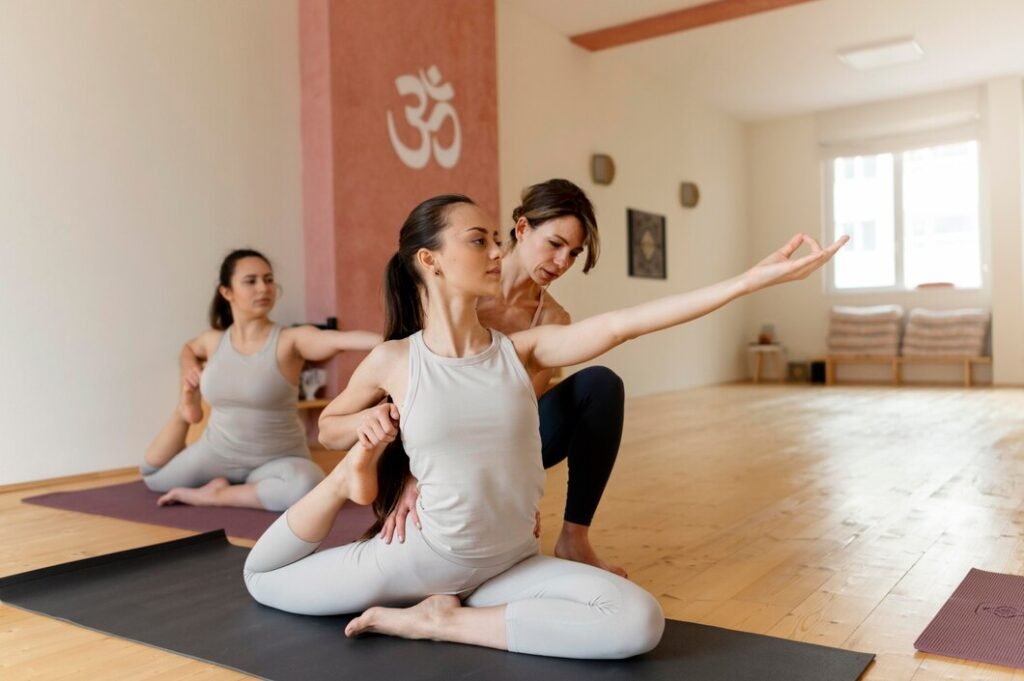
In the Yoga Sūtra II.46, sthiraṃ sukham āsanam, Patañjali gives a definition that feels very simple but, at the same time, extremely deep: the posture should be steady and also comfortable. When I studied Edwin Bryant’s commentary on this sutra, I understood more clearly that Patañjali is not only talking about the physical posture. He is speaking about the internal state we carry when we practise. For an āsana to be truly yoga, it needs to hold these two qualities together—sthira, the stability, and sukha, the softness or ease. One without the other loses its meaning. They are like two energies that depend on each other to create harmony.
Here the traditional definitions are important:
STHIRA (स्थिर): firmness, stability, strength, steady, alertness and readiness without aggression, discipline, structure, continuity over time, the ability to stay without collapsing, the presence of awareness that does not shake easily. According to Vyāsa, sthira is the “absence of agitation.” In modern yoga, especially Krishnamacharya’s approach, sthira also means intentional engagement guided by breath.
SUKHA (सुख): ease, comfort, agreeable, happy, openness, spaciousness in body and mind, absence of unnecessary tension, the ability to stay without suffering, a quality of softness that does not collapse. Vyāsa describes sukha as “pleasantness and freedom.” Krishnamacharya explains sukha as the natural flow of breath and the absence of force.
For an āsana to be truly yoga, it needs to hold these two qualities together. One without the other loses its meaning. They support each other like two complementary forces.
This idea reminds me a lot of the Taoist concept of yin and yang. Yin is more soft, receptive, quiet—very similar to sukha. Yang is active, structured, full of direction—like sthira. They are opposites, but they are also partners. One exists because the other is there. If there was only yin, everything would collapse; if there was only yang, everything would burn out. In our practice, the same happens. Without the effort, there is no shape. Without the ease, there is no breathing inside the shape.
In the Krishnamacharya tradition, this balance is extremely important. Krishnamacharya always said that the practice should adapt to the person. So when we move or stay in a posture, we try to find this meeting point where the breath creates structure but also brings softness. If I only push, I feel tension and the body closes. If I only relax, I collapse and lose my centre. In Vinyasa Krama this becomes very clear: every movement has purpose (sthira), and every transition invites smoothness (sukha). It is like the practice is constantly teaching me how to be strong without becoming hard, and soft without losing direction.
I also see a connection with Newton’s movement law that says: for every action there is an equal and opposite reaction. In yoga this appears all the time. When I apply effort in one part of the body, another part reacts. If I push too much, the breath reacts with agitation. So I need sukha to balance. And when I become too soft, the posture reacts with instability, asking for sthira. It is a continuous conversation between these two forces.
In the end, sthira and sukha show me that yoga is not about choosing one side. It is learning how to hold both—effort and surrender, yin and yang, action and reaction—and realise that one can only exist because the other is there.
The Play of Vritti – Samskara – Kleśa and to reduce them.
The vṛttis and the kleśas are connected in the functioning of the mind. Vṛttis are the mental activities happening in the present moment: thinking, remembering, imagining, analysing, or emotional reactions. Kleśas are the underlying causes that disturb the mind: ignorance, ego identity, attachment, aversion, and fear of loss. These kleśas influence how vṛttis appear and make certain patterns stronger.
Behind both of these is the concept of saṁskāra, which refers to mental impressions left by past actions and past thoughts. A vṛtti creates a saṁskāra, and repeated saṁskāras strengthen the kleśas. Then the kleśas generate new vṛttis. This produces a continuous cycle that keeps the mind unstable.
According to Patañjali, this cycle can be reduced through abhyāsa (consistent practice) and vairāgya (non-attachment). Abhyāsa trains the mind to stay steady and return to the chosen point. Vairāgya weakens the tendency to react to every thought or desire. When both are applied, the vṛttis become quieter, the kleśas lose influence, and the saṁskāras gradually stop producing strong reactions.
The five states of mind describe the stages of this process.
In mudha (dull) and kṣipta (distracted), vṛttis dominate, kleśas are strong, and saṁskāras repeatedly bring the same habits.
In vikṣipta, the mind becomes partially focused, but still unstable. Here abhyāsa and vairāgya begin to have a real effect.
In ekāgra, the mind becomes one-pointed. Vṛttis reduce significantly, kleśas weaken, and saṁskāras do not rise as easily.
In niruddha, the fluctuations are restrained, and kleśas and saṁskāras stop disturbing the mind.
In summary:
Vṛttis are the active thoughts; kleśas are the deeper causes; saṁskāras are the stored impressions.
Abhyāsa and vairāgya reduce all three, and the five mind states show the progression toward mental stability.